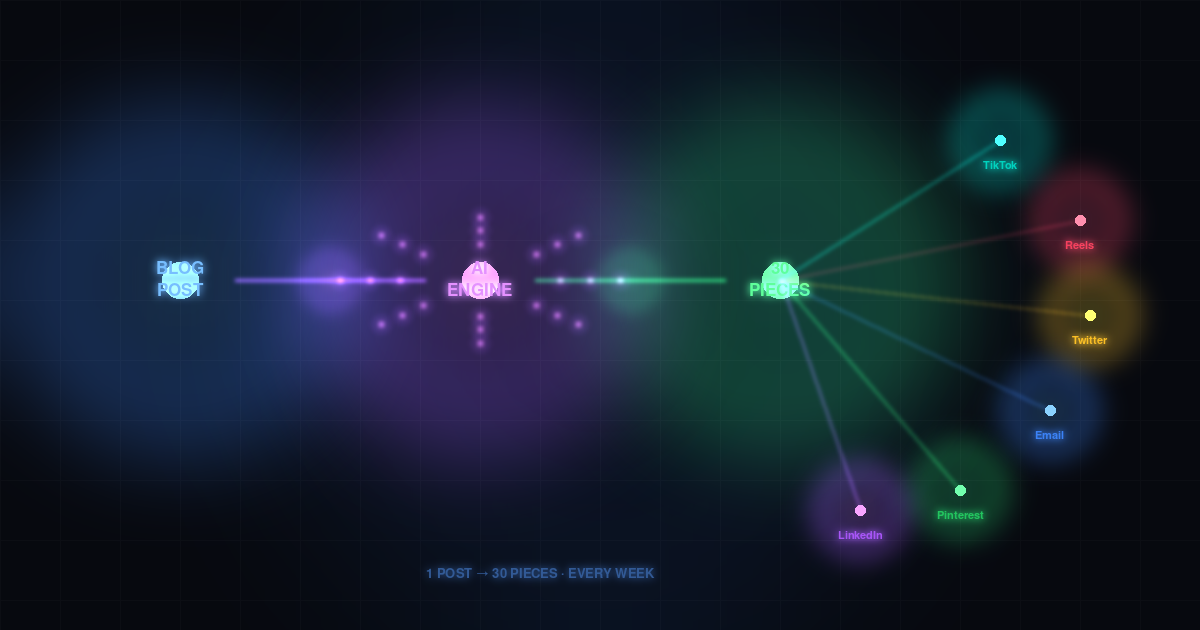
The content treadmill breaks people. You need to post daily on TikTok, twice a day on Pinterest, keep the blog alive, answer questions on Reddit and Quora, send the weekly email — and somehow generate ideas for all of it. I refused to run that race. Instead, I built a repurposing system that turns one idea into everything else. Here's the exact workflow.
Why content repurposing is the only sustainable model
Creating original content from scratch for every platform is a full-time job. Repurposing one piece of content across platforms is a 2-hour weekly task. The output is nearly identical — in volume and quality — but the input is fraction of the time.
The insight that makes this work: every piece of content you create contains multiple angles, formats, and entry points. A 2,000-word blog post on affiliate marketing contains at least 6–8 distinct TikTok hooks, 10–12 Pinterest pin descriptions, 3 Reddit posts, 2 Quora answers, and a full email newsletter. The ideas are already there. You just need a system to extract them.
The source content rule: everything starts with one long-form piece
The system only works if you start with rich source content. A 1,500–2,500 word blog post is the best starting point because it forces you to think a topic through completely. A YouTube video with a full transcript works equally well. A short social post does not — there isn't enough material to repurpose.
My weekly workflow: Monday I write or record one piece of source content. That's the only original creative work of the week. Everything else — the 30 pieces that follow — is AI-assisted transformation of that one piece.
Step-by-step: the exact repurposing workflow
Step 1 — paste the full article into Claude
Open Claude (or ChatGPT) and paste your full blog post. Then run the following prompt: "Here is a blog post. I need you to extract the 8 most compelling individual points from this article, then write a TikTok hook + 60-second script for each point. Each script should open with a bold, specific claim, give 3 practical takeaways, and end with one clear call to action. Tone: direct, conversational, no fluff."
You get 8 scripts in one shot. Edit them for your voice — add one personal detail or real number to each — and you have a week's worth of TikTok content.
Step 2 — generate Pinterest pins
Prompt: "From the same article, write 12 Pinterest pin descriptions. Each should be 150–200 characters, include the primary keyword, and end with a question or action prompt. These will link to the blog post."
Pinterest rewards volume and consistency. 12 pins from one post means you can post 2 pins per day for 6 days. If you use Canva or Tailwind to create visuals, pair each Prompt: "Write 3 Reddit posts for the subreddits r/affiliatemarketing, r/beermoney, and r/sidehustle based on this article. Each post should read as a genuine personal experience, not a promotion. Include one specific result or number. Do not link to the blog post in the post itself — only in a comment if asked." Reddit detects promotional content aggressively. The AI draft needs editing to sound personal and specific. Add a detail that only someone who actually does this would know. Then post it to the right subreddit and engage with comments. Only add the blog link in a reply if someone explicitly asks for more detail. Prompt: "Write an email newsletter based on this article. Subject line: intriguing but not clickbait, under 50 characters. Body: 200–300 words. Structure: one insight, one specific number, one practical action, one link. Tone: personal, written in first person, like a note from a friend." This takes 5 minutes. Edit the draft to personalise the opening — reference something current, a recent result, or a question someone asked you. Your subscribers can tell when an email is genuine versus generated. Prompt: "Find 2–3 questions on Quora that this blog post directly answers. Write a 200-word answer for each question that gives real, specific information and ends by mentioning (but not linking to) the article for readers who want more detail." Quora answers rank in Google and get cited in AI Overviews. A well-written Quora answer on a relevant question can drive consistent traffic for 12–24 months. Don't skip this step. Here's the full count from a typical repurposing run: That's 30 pieces of platform-specific content from one source, produced in about 90 minutes total. The weekly content calendar writes itself. Claude for all text repurposing — it handles long documents better than most tools and maintains consistent tone across formats. The free tier covers most weekly workflows. See our ChatGPT review if you want a comparison. Opus Clip for video repurposing — if you record a YouTube video, Opus Clip automatically clips it into shorts ranked by "virality score". The Opus Clip review has the full breakdown. Tailwind for scheduling Pinterest pins — batch-upload your 12 pin descriptions and set a posting schedule. See the Tailwind review for setup details. Editing. The AI output is a first draft, not a finished post. On Reddit and Quora in particular, a clearly AI-written post gets downvoted or removed. Spend 5 minutes per piece adding one specific detail that sounds human — a result you actually got, a mistake you actually made, a tool you actually use. That one detail is the difference between content that converts and content that gets flagged. The exact prompts I use for content repurposing, plus the weekly workflow template — all free in the 7-day starter kit.Step 3 — Reddit and Quora posts
Step 4 — email newsletter
Step 5 — Quora answers
The 30-piece output from one 2,000-word post
The tools I actually use
The one thing most people skip
Get the free AI content starter kit