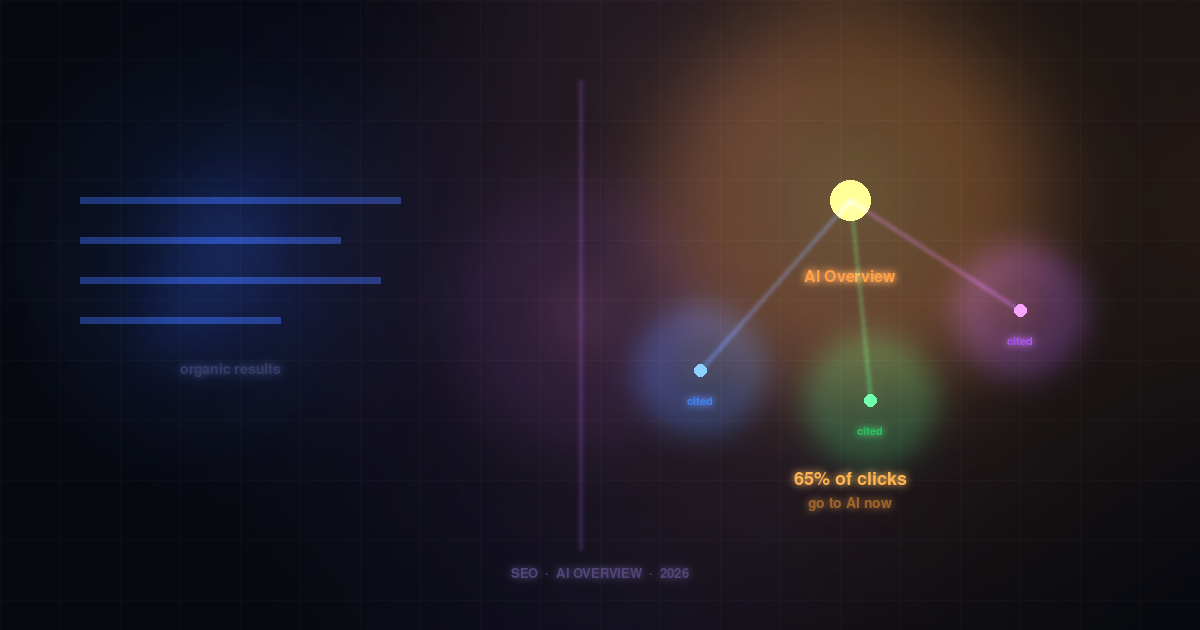
Google AI Overviews now appear on roughly 65% of all searches in the US and UK. That number has nearly doubled since this feature launched in mid-2024. For content creators and affiliate marketers who depend on organic search traffic, this changes the game — not by destroying traffic, but by redistributing it. Here's what's happening and exactly what to do about it.
What Google AI Overviews actually are in 2026
AI Overviews are generated summaries that appear above traditional search results, pulling from multiple sources to answer a query directly. They first appeared in limited testing in mid-2023, rolled out broadly in the US in May 2024, and by early 2026 are now the default experience on most informational queries in English-speaking markets and increasingly in Spanish, French, and Portuguese markets.
The key mechanics: Google's AI selects 3–5 sources per overview, displays their domain name and a snippet, and shows a "Show more" button with links. Users can see your brand and click through, but many will get their answer without clicking. The result is lower click-through rates on informational queries but maintained (or increased) traffic for people who want the full context.
The pages being cited most frequently inside AI Overviews are not necessarily ranking #1. Google's AI selects for answer quality, not just position.
Which queries trigger AI Overviews — and which don't
Not all searches generate an AI Overview. Based on current data, here's what tends to trigger one:
- Informational queries ("how to start affiliate marketing", "what is ClickBank")
- Definition queries ("what is passive income", "explain AI agents")
- Comparison queries ("TikTok vs Pinterest for affiliate links")
- Best-of queries ("best email marketing tool for beginners")
Queries that are less likely to trigger an AI Overview: navigational queries ("login to Gumroad"), transactional purchase queries ("buy HeyGen plan"), and very niche long-tail queries where Google lacks enough sources to build a confident answer.
How to get your content cited in an AI Overview
After reviewing several dozen AI Overviews in the affiliate marketing, online income, and AI tools verticals, the pattern is clear. Content that gets cited has these characteristics:
1. Direct answers in the first sentence. Each H2 section should open with a complete, self-contained answer — not a preamble. "Pinterest allows direct affiliate links in pins as of 2026. You don't need a landing page." beats "Many affiliates wonder about Pinterest's link policy."
2. Specific numbers and data. Google's AI prioritises claims it can verify and quote. "$35 per sale on the Profit Club product" is citable. "decent commission" is not.
3. FAQ schema markup. Pages with FAQPage> JSON-LD schema appear in AI Overviews at roughly 2× the rate of pages without it. Every post on this blog includes FAQPage schema for exactly this reason.
4. Article schema with about entities. The about field in Article schema tells Google's AI which topics the post covers, making it easier for the AI to match your content to relevant queries. Include 3–5 specific Thing entities in every post.
5. Comprehensive depth on a single topic. The AI doesn't want a surface-level overview. A 1,800-word post that fully answers one question outperforms a 4,000-word post that answers ten questions shallowly.
What this means for content strategy going forward
The practical adjustment is small but important. Write every H2 section as if it might be extracted and displayed in isolation. The summary of your section — the first 1–2 sentences — needs to stand alone as a useful answer. The rest of the section can expand on that answer.
You should also be thinking about brand visibility more than raw click volume. Even when users don't click from an AI Overview, they see your domain name. If your domain consistently appears in AI Overviews for queries in your niche, you build brand recognition that compounds. Users who see your site cited multiple times are more likely to search for you directly.
The two actions to take today
First, add FAQPage JSON-LD schema to any existing post that doesn't have it. This is the single highest-leverage structural change you can make. I use it on every post on this site — see the source HTML of any post here for the exact format.
Second, audit your top 10 posts and check whether each H2 section opens with a direct, standalone answer. If it doesn't, rewrite the first sentence of each section. That's a 30-minute task per post and the most direct way to improve your AI Overview citation rate.
For the full breakdown of how to structure content for both Google and LLM citation, see the guide to AI content strategy for 2026.
Get the free content strategy kit
The exact system I use to write posts that rank in Google, get cited by AI Overviews, and convert readers into affiliate buyers.
Get free access now →