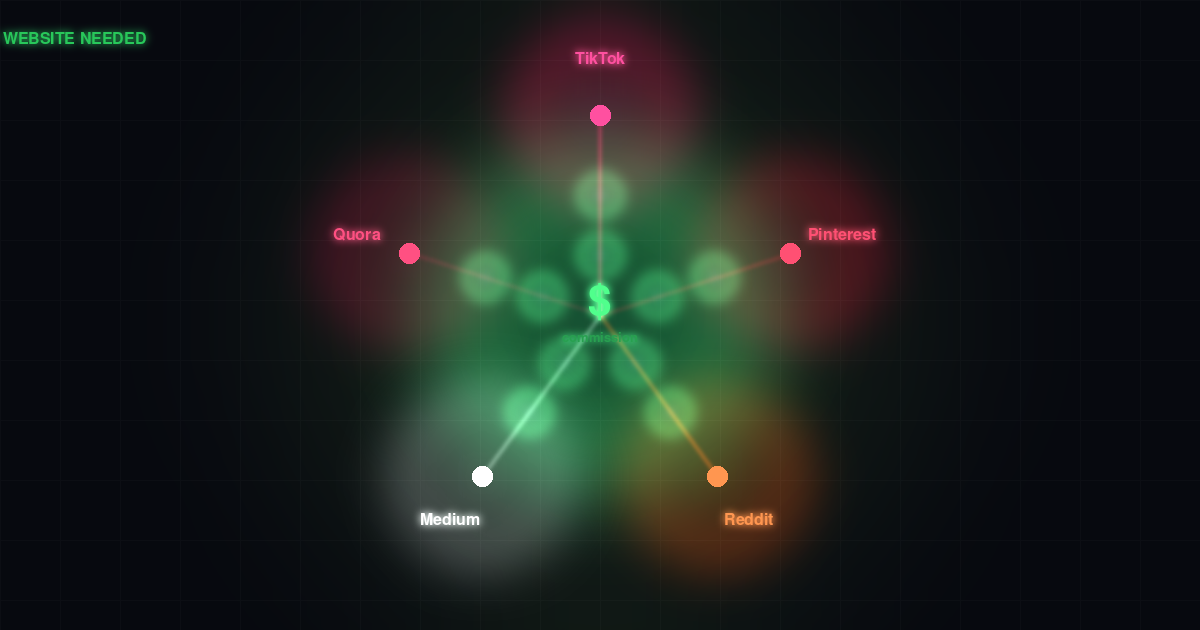
You do not need a website to earn affiliate commissions. The idea that you need to build a site, write 50 blog posts, and wait 12 months for SEO traffic before earning a cent is one of the most persistent myths in online business. Here are 5 free platforms where beginners are earning real affiliate income today — no domain, no hosting, no web development required.
This isn't theoretical. I've used all 5 of these to drive traffic to affiliate offers including ClickBank products and the Digistore24 Monetary Distribution programme. Each one has a different profile: some are fast, some compound over time, some convert at higher rates. I'll break down exactly how each one works and what you should post.
Why you don't need a website to start
A website has one core advantage: you own the traffic channel. You can build an email list, rank in Google, and keep visitors coming back. Those are real benefits — but they take 6–18 months to materialise. A website is a long-term asset, not a starter tool.
The 5 platforms below have existing audiences already. They bring the traffic — you supply the content. That trade-off means you're dependent on their rules and algorithms, but you can also start earning within weeks rather than months. For someone just starting out, that speed matters.
The other thing worth saying clearly: once you're earning from these platforms, building a website becomes much lower risk. You already know which offers convert, which content topics resonate, and what your audience actually wants. That's far better data than most people have when they start building a site from scratch.
Platform 1: TikTok
TikTok — affiliate link in bio, content drives clicks
One affiliate link in your TikTok bio. Every video you post points viewers toward that link. With consistent posting (3–4 videos per week), you can get meaningful click volume within 3–4 weeks even with zero followers.
TikTok is the only platform where a completely new account with zero followers can reach thousands of people on its first video. The algorithm distributes content based on engagement signals, not follower count. That's the structural advantage no other platform offers beginners.
The mechanics for affiliate marketing on TikTok are simple: put your affiliate link (or a redirect like a Linktree or a direct landing page) in your bio. Then create 60–90 second videos that address a problem your offer solves. Say the keyword in the first 3 seconds of the video. Show the keyword on screen immediately. Put the keyword in the first word of your caption. These three steps are what force TikTok SEO when you have no followers.
What content actually works
The highest-converting TikTok content for affiliate offers in the make-money-online niche follows a consistent pattern: a bold claim in the first 3 seconds, a short explanation of what the system or product is, and a single clear CTA at the end ("link in bio"). Videos that show a result — a commission screenshot, a before/after — consistently outperform pure talking-head explainers.
One important caveat: TikTok bans raw affiliate links on some networks (ClickBank hoplinks are often flagged). The fix is to route through a redirect — either a free Linktree profile, a simple landing page, or a custom short link. Don't put the raw hoplink in your bio or captions.
Platform 2: Pinterest
Pinterest — direct affiliate links in pins, traffic compounds over months
Pinterest allows direct affiliate links in pins. Unlike TikTok, where content fades in 48–72 hours, a Pinterest pin can drive traffic for 2–3 years. Post 5 pins per day for 30 days and you have a portfolio of 150 pieces of content working for you around the clock.
Pinterest is the most underrated platform for affiliate marketing without a website. Most people think of it as a recipe and home décor platform, but it has a large and active audience searching for money-making ideas, productivity tools, and digital products — exactly the kind of thing ClickBank and Digistore24 offer.
The workflow is: create a simple Canva graphic (1000×1500 px, dark background, 2–3 lines of text), write a keyword-focused description, and put your affiliate link directly in the pin's destination URL. Pinterest's algorithm surfaces pins to users based on keyword match and engagement, so title and description optimisation matters more than follower count.
What makes a pin convert
The pins that drive affiliate clicks share a few characteristics. The image communicates the benefit immediately — not "check this out" but "I made $300 this week with this tool". The description leads with a keyword and includes the benefit in the first sentence. The affiliate link goes to a landing page that matches the promise of the pin, not to a generic product homepage.
One specific tip: create separate Canva templates for each offer, so you can pin the same offer with different imagery and copy variants. Pinterest rewards fresh content, and having 10–20 pin variants per offer significantly increases distribution.
Platform 3: Reddit
Reddit — genuine community participation, highest-converting traffic
Reddit sends the highest-converting affiliate traffic of any platform on this list. The catch: you have to earn trust first. Reddit users are allergic to obvious promotion. Done right, a single Reddit comment can drive dozens of high-quality clicks.
Reddit's search volume is enormous and largely untapped by affiliate marketers. Subreddits like r/beermoney, r/juststart, r/affiliatemarketing, r/sidehustle, and r/passive_income have millions of members actively seeking exactly what you're promoting. The trick is to participate genuinely before dropping any links.
The approach that works: spend the first two weeks in your target subreddits answering questions, giving real advice, and building a comment history. Once your account looks like a genuine participant, you can include an affiliate link in a relevant, detailed post. Frame it as a personal experience ("I've been using X for 3 months, here's what I found") rather than a promotion. Moderators and users respond very differently to these two framings.
What not to do on Reddit
Don't create a new account and immediately post affiliate links. Reddit users will check your comment history, and a fresh account with only promotional posts gets banned quickly. Don't post the same link across multiple subreddits — that's spam and will get you permanently blocked. The investment here is 2–3 weeks of genuine participation before you'll see real click-through. But when it works, the clicks convert at 2–5x the rate of cold social media traffic.
Platform 4: Medium
Medium — free articles that rank in Google and include affiliate links
Medium articles rank in Google. A well-written 1,500-word article on Medium about a specific topic can appear on the first page of Google search results within weeks. Medium's domain authority does the ranking work for you.
Medium is a publishing platform with very high domain authority — pages regularly rank on Google page 1 for medium-difficulty keywords without any additional SEO work from the author. You write a thorough, specific article on a topic your affiliate offer addresses, include your affiliate link naturally in the body (with a disclosure), and the article ranks and converts on autopilot.
The content that performs on Medium for affiliate income tends to be specific and practical: "The exact ClickBank funnel I used to make my first sale", "Why I switched from Amazon Associates to Digistore24", "How I built a $300/month affiliate income with no website in 90 days". These titles have clear keyword intent and a personal experience framing that Medium readers respond to.
Medium's affiliate link policy
Medium allows affiliate links with a disclosure. Put a one-sentence disclosure at the top of your article: "This article contains affiliate links. If you buy through them I earn a commission at no extra cost to you." That's the entire compliance requirement. Medium Partner Programme (which pays you per read) is separate from affiliate income — you can earn from both simultaneously on the same article.
Platform 5: Quora
Quora — answers to specific questions that rank in both Quora and Google
Quora answers appear in Google search results. A detailed answer to a question like "how do I start affiliate marketing with no money" can drive traffic for years. Quora also allows affiliate links in answers with a disclosure.
Quora has 300+ million monthly visitors and its content ranks heavily in Google for question-based searches. The user intent is high — people asking "what is the best affiliate programme for beginners" are very close to taking action. A thorough, specific answer to a high-volume question is a permanent asset.
The content approach: search for questions directly related to your offer's benefit (e.g., "how to make money online without experience", "best passive income for beginners", "how does ClickBank work"). Write a 400–600 word answer that genuinely addresses the question, and at the end, reference your affiliate resource as one way to get started. Quora's community guidelines allow this as long as the answer provides value independent of the link.
Which platform to start with
If you're starting from zero and want the fastest path to your first commission, start with Pinterest. Post 5 pins per day for 30 days using Canva templates. Put your affiliate link directly in the pin URL. Pick one ClickBank or Digistore24 offer and create 30–50 pin variants for it over the first month.
Add TikTok in month two once you have a content rhythm. Reddit and Medium are medium-term plays (3–6 weeks before meaningful traffic). Quora compounds slowest but lasts longest.
| Platform | Time to first clicks | Content lifetime | Effort level |
|---|---|---|---|
| TikTok | Days | 48–72 hours | Medium (video) |
| 1–2 weeks | Months to years | Low (graphics) | |
| 2–3 weeks | Weeks to months | Medium (writing) | |
| Medium | 2–4 weeks | Months to years | Medium (writing) |
| Quora | 3–5 weeks | Years | Low (writing) |
Honest take
Affiliate marketing without a website is real, but it isn't passive on day one. The "passive income" part only applies once you've built up a library of content — 50+ pins, 30+ TikToks, 10+ answers. That takes 4–8 weeks of consistent daily work. Anyone claiming you'll earn $1,000 in your first week without a site or an audience is selling something. The honest timeline is: first commission in weeks 2–6 if you're consistent, first $300+ month by month 3–4. That's not a fantasy, but it does require showing up every day.
The one mistake that kills results on every platform
Promoting an offer you haven't actually checked. Every platform's users can tell when a recommendation is hollow — when the review has no specifics, when the claim is vague, when the writer clearly hasn't used the product. The affiliate marketers who convert consistently on no-website platforms write from a position of genuine knowledge about the offer: what it costs, what it delivers, who it's actually for, what the downsides are.
Before promoting any offer, read the sales page carefully. Note the specific claims it makes. Note the price. Note what the buyer actually gets. Then write your content with those specifics. That specificity is what separates content that converts from content that gets ignored — and it's what makes your posts survive moderation on Reddit and Quora.
For more on the mechanics of choosing the right affiliate product, see the guide to getting started with affiliate marketing and AI tools, or the ClickBank beginner walkthrough.
Get the free affiliate starter kit
The exact workflow for setting up Pinterest, TikTok, and your first ClickBank offer — all in one 7-day guide. No experience needed.
Download free now →