An email subscriber is worth 10× a social media follower. I can say that with conviction because I've watched both. Social posts disappear in 48 hours. An email sequence works for you every time someone new joins your list — the same emails, converting the same way, without any additional work from you. Here's how to build one with AI in an afternoon.
Why email converts better than social for affiliate marketing
The average email click-through rate is 2.5–4%. The average organic TikTok or Instagram click-through to a link in bio is 0.3–0.8%. That's a 5–10× difference on the same offer. The reason is trust and intent: people on your email list opted in deliberately. They gave you permission to send them things. That consent is the difference between a warm lead and a cold scroll.
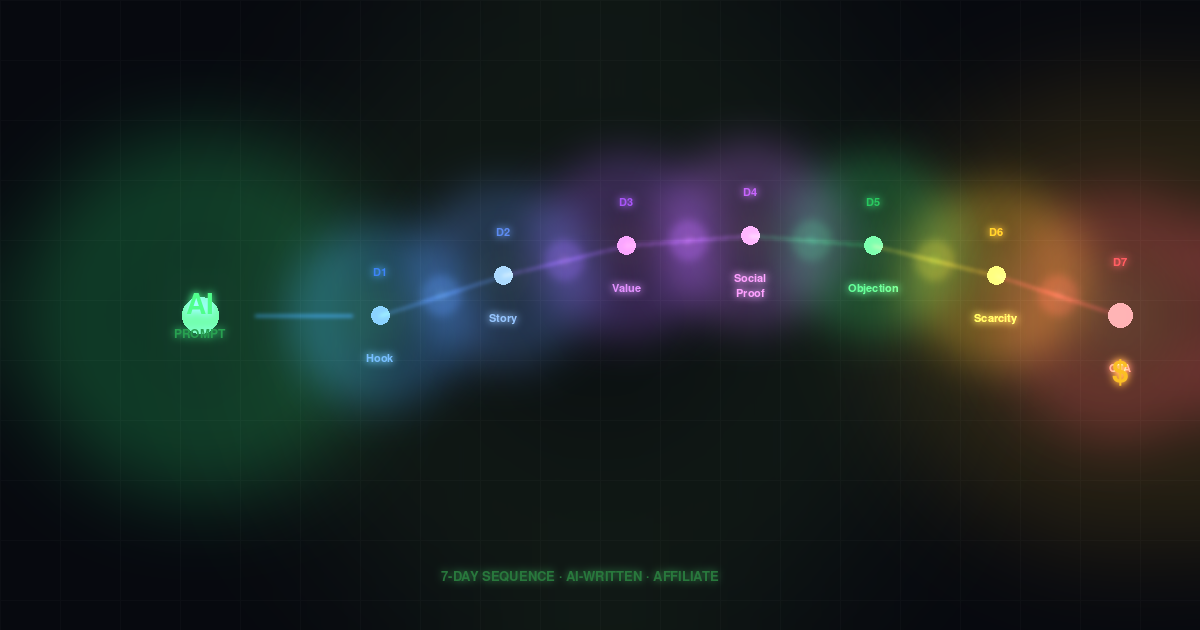
A 7-day welcome sequence is the mechanism that converts new subscribers into buyers. You deliver value for 4–5 days, build trust, then make an honest affiliate recommendation. Done correctly, this generates passive commissions on autopilot — every new subscriber enters the sequence without any additional effort from you.
The 6-email sequence structure that converts
Email 1 (immediately on signup): deliver + set expectations
Subject: "Your [lead magnet] is here — plus what's coming next"
Deliver exactly what you promised — the free kit, the PDF, the course access. Then in 2–3 sentences, tell them what the next 6 days look like: "Over the next week, I'm going to share the exact system I use to earn affiliate commissions with AI tools. Tomorrow: how I picked my first product. Day 3: the content strategy. Day 5: the tool that saved me 8 hours a week." This sets expectations and dramatically improves open rates for the rest of the sequence.
Email 2 (Day 2): your story
Subject: "How I went from zero to first commission (the honest version)"
Write 200–300 words. Your starting point, the thing that didn't work, the thing that finally did. One specific number ("first $35 commission, 6 weeks in"). End with a micro-lesson: the one thing this story teaches. No pitch. No product mention. Just the story.
Email 3 (Day 3): your best free content
Subject: "The [topic] system I use every week"
Link to your single best blog post or guide. Summarise the value in 3 sentences. Tell them why this post matters to them specifically. This email exists to build credibility and drive traffic to your best content. No pitch.
Email 4 (Day 5): set up the product recommendation
Subject: "The problem with [common approach]"
Write about the problem your affiliate product solves — without naming the product. "I spent 4 hours a week manually creating content variations for different platforms. Then I found a tool that does it in 20 minutes." End with a teaser: "Tomorrow I'll show you exactly what that tool is."
Email 5 (Day 6): the story + recommendation
Subject: "The tool that changed my weekly workflow (honest take)"
Now name the product. Tell one specific story of using it — a real result, a time it saved you, something that surprised you. Include one honest criticism ("The free tier is limited but the $X/month plan is worth it for anyone posting more than X times a week"). Then place your affiliate link with a clear disclosure: "This is an affiliate link — I earn a commission if you sign up, at no extra cost to you."
Email 6 (Day 7): the direct CTA
Subject: "If you're serious about [desired outcome], this is the tool"
Short email — 100 words max. Restate the benefit in one sentence. Name the specific plan you recommend. Include the affiliate link. Done. No padding, no extra stories. The reader has had 5 days of value. They know if this is for them.
How to use AI to write the sequence
The prompt that generates a complete first draft: "I'm writing a 6-email affiliate welcome sequence for [describe your audience]. My lead magnet is [describe it]. The affiliate product I'm promoting is [name, price, commission, what it does]. My own story in brief: [2–3 sentences]. Write all 6 emails following this structure: [paste the structure above]. Each email should be 200–300 words, written in first person, warm but direct, no marketing fluff. Include subject line options for each."
Feed this to Claude or ChatGPT. You'll get 6 draft emails in about 90 seconds. Then spend 20 minutes editing: personalise the opening of each email, add one specific detail that only you know, and make sure the voice sounds like you — not like a template.
Setting up the automation in Systeme.io
Systeme.io is the platform I recommend for beginners because it includes email automation in the free tier up to 2,000 subscribers. Setup takes about 45 minutes:
- Create a new funnel → Landing page for your lead magnet
- Set up the opt-in form → connects to your email list
- Go to Emails → Create a campaign → Add each email with the correct delay (0 days, 1 day, 1 day, 2 days, 1 day, 1 day)
- Set the trigger: new subscriber added to list → start campaign
- Test by subscribing yourself with a secondary email address
The full Systeme.io review and setup guide is here. For an alternative with more advanced segmentation, see GetResponse.
The math on a 500-person list
Here's why building this sequence is worth doing even when your list is small. 500 subscribers, 40% open rate on the pitch email = 200 opens. 5% click-through = 10 clicks to the affiliate offer. ClickBank Profit Club converts at roughly 3–5% on average. At 4% conversion: 0.4 sales × $35 commission = $14. Per month, assuming 50 new subscribers/month: $14 × 0.75 (as not everyone gets to email 6 within 30 days) = ~$10/month from a tiny list.
Scale to 5,000 subscribers and the same math produces $100–150/month in passive income from one sequence. At 20,000 subscribers with a better-converting product ($105/sale recurring, like Digistore24's Monetary Distribution), the numbers are materially different. This is what "building an asset" means.
Get the email sequence template
The exact 6-email sequence I use, with AI prompts and subject line options — included in the free 7-day starter kit.
Get free access now →