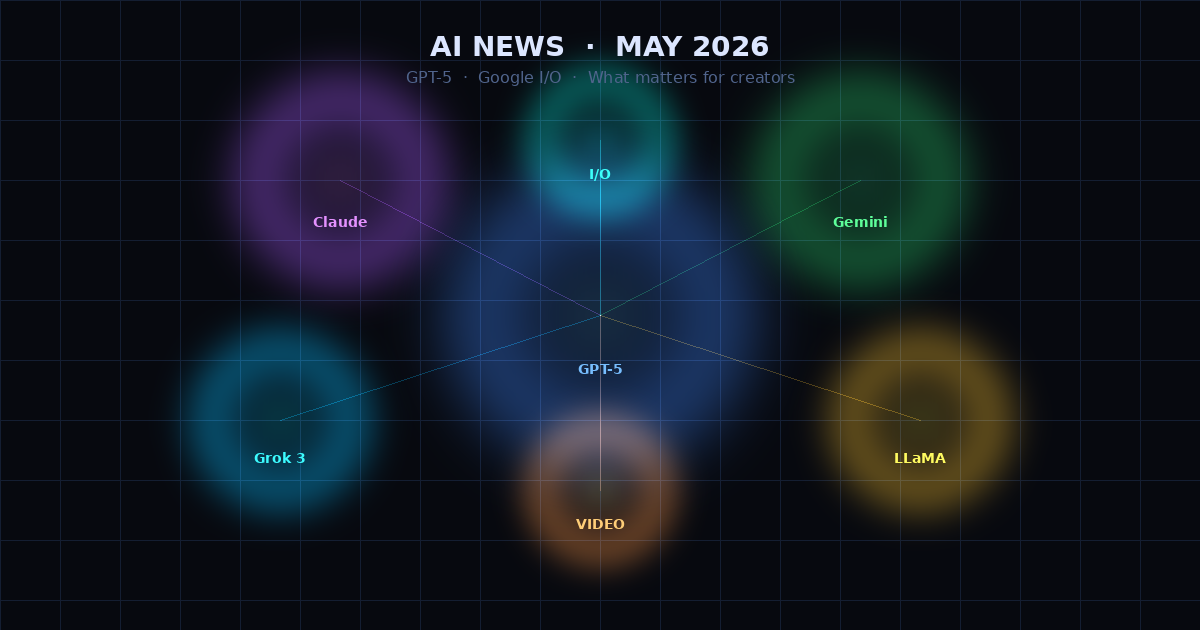
Five major AI models are now actively competing for the same users: GPT-5, Claude 4 Sonnet, Grok 3, Gemini 2.0 Flash, and Llama 4. If you're building a content business with AI, you don't need all of them — you need the right two or three for your specific tasks. Here's an honest breakdown of each, what they're actually good at, and which ones I use daily.
GPT-5 — best for structure and complex instructions
GPT-5 launched May 1st and is the most capable model OpenAI has shipped. The headline improvement over GPT-4o is multi-step reasoning — it follows a chain of logic across longer conversations without losing the thread. For content creation, this means two things: longer documents maintain coherence, and complex prompts (with many conditions and requirements) are followed more reliably.
Where GPT-5 beats every other model: structured output. If you need a perfectly formatted comparison table, a numbered list with specific character counts, or a content calendar with specific platform requirements, GPT-5 executes these more cleanly than any alternative.
Where it still struggles: natural voice. GPT-5 prose sounds slightly more mechanical than Claude 4. It's 90% of the way there, but if you read it alongside Claude output, the difference is noticeable.
Cost: ChatGPT Plus is $20/mo and includes GPT-5 access. API access runs approximately $15 per million input tokens.
Claude 4 Sonnet — best for writing, tone, and brand voice
Claude 4 Sonnet is the model I use most for actual content production. It produces the most natural-sounding English prose of any current model — blog posts, email sequences, and social captions all read like they were written by a skilled human writer. It also follows detailed style guides (like our content repurposing framework) more reliably than GPT-5.
The Claude 4 family also has the most consistent ethical guardrails, which matters less for most content tasks but is relevant if you're writing in sensitive niches (health, finance, legal disclaimers).
Claude 4 Haiku — the faster, cheaper version — is excellent for high-volume tasks: generating 50 email subject line options, first-draft LinkedIn posts, or social captions. At $0.25 per million input tokens, it's essentially free for production volume work.
Where Claude underperforms: real-time information. Claude's knowledge has a cutoff and it doesn't have live web access by default (unlike Grok 3). For anything that requires current information, you'll need to provide the context or use a different tool for research.
Grok 3 — best for research and trend spotting
Grok 3 from xAI has live web access baked in and is deeply integrated with X (formerly Twitter), which makes it uniquely useful for one specific task: real-time trend identification. If you want to know what's trending in your niche right now — not 6 months ago — Grok 3 surfaces it faster than any other model.
For actual content generation, Grok 3 is behind GPT-5 and Claude 4. The prose quality is acceptable but not remarkable. The best workflow: use Grok 3 to research and identify trending topics, then hand off to Claude or GPT-5 to write the content.
Grok 3 is free with a basic X account, and Grok 3 Heavy (the more capable reasoning version) is available on X Premium+ ($40/mo).
Gemini 2.0 Flash — best for speed and Google integration
Google's Gemini 2.0 Flash Thinking is the fastest frontier model available. Response times are 30–50% faster than GPT-5 or Claude 4 Sonnet at comparable quality. For time-sensitive tasks — quick content edits, fast ideation, rapid fact-checking — the speed advantage is genuinely useful.
The Google ecosystem integration is Gemini's strongest differentiator. If you use Google Docs, Slides, or YouTube Studio, Gemini works natively inside these tools in ways that Claude and GPT don't. The YouTube integration specifically — which can suggest thumbnails, generate chapters, and draft description text — is useful for video creators.
The honest comparison table
| Task | Best model | Second choice |
|---|---|---|
| Long-form blog posts | Claude 4 Sonnet | GPT-5 |
| Email sequences | Claude 4 Sonnet | GPT-5 |
| Structured outlines | GPT-5 | Claude 4 |
| Trend research | Grok 3 | Perplexity |
| Captions & short copy | Claude 4 Haiku | GPT-5 |
| Fast ideation (speed) | Gemini 2.0 Flash | Claude 4 Haiku |
| Code & automations | GPT-5 | Claude 4 Sonnet |
My actual daily workflow in May 2026
Here's what I use and why — no theory, just what's running daily:
- Morning research: Grok 3 — what's trending in the AI/affiliate space right now?
- Content outline: GPT-5 — give it the topic, get a structured outline with H2s, word targets, and FAQ questions
- First draft: Claude 4 Sonnet — write the full post from the outline, following our style guide
- Edit pass: Me — add personal examples, specific numbers, honest take boxes
- Repurposing (captions, pins, emails): Claude 4 Haiku — fast and cheap
Total AI tool cost for this workflow: $40/mo (ChatGPT Plus + Claude Pro). Grok 3 and Gemini I use on free tiers. This replaces what would previously have been a content team costing $3,000–5,000/mo in freelancer fees.
Want the exact AI content workflow we use?
The free starter kit includes our content production system — prompts, templates, and the daily workflow that runs Break Free. Set it up in a weekend.
Get free access now →