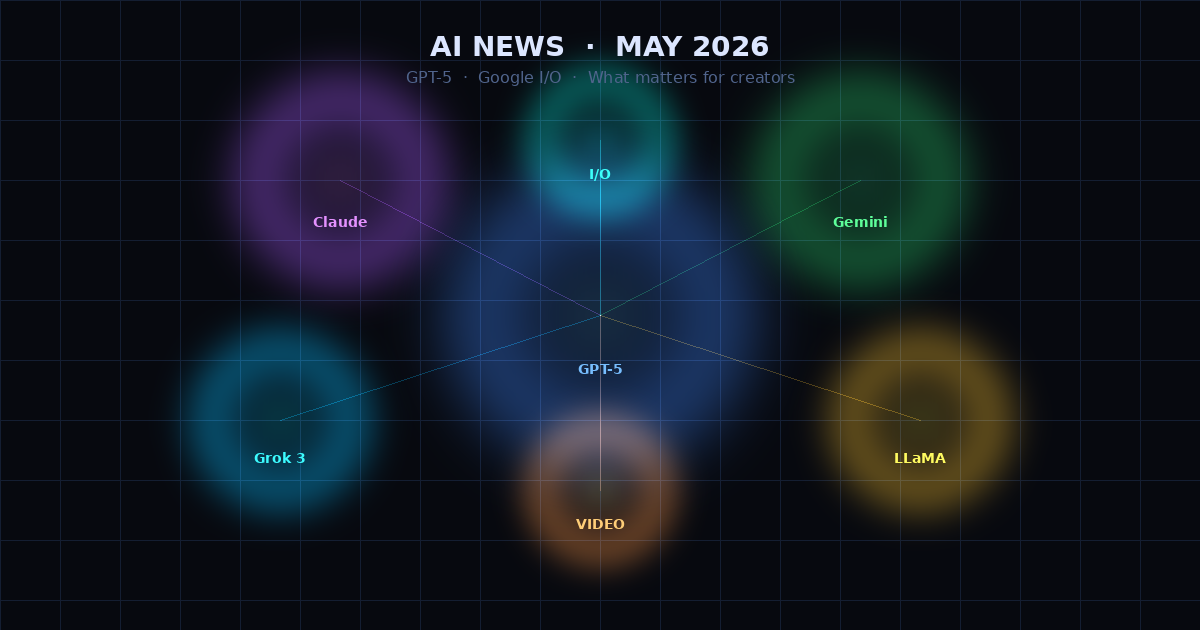
May 2026 opened with the biggest AI week since ChatGPT launched. GPT-5 went live, Google I/O dropped a wave of announcements, and AI-generated video quietly crossed a quality threshold that makes it genuinely useful for content creators. Here's the short version — what happened, what it means, and the one thing I'm changing in my own content workflow because of it.
GPT-5 is live — here's what actually changed
OpenAI released GPT-5 on May 1st. It's available to ChatGPT Plus subscribers immediately and to API users starting week two. The headline improvement is reasoning quality — GPT-5 handles multi-step tasks significantly better than GPT-4o, especially in cases where 4o would lose the thread after 3–4 steps.
For content creators, the practical change is noticeable in two areas:
- Long-form content — GPT-5 maintains consistency across 2,000+ word pieces in a way 4o struggles with. Character voices, argument structure, and formatting don't drift.
- Instruction following — if you use detailed system prompts or content guidelines (like our content repurposing system), GPT-5 follows them more reliably. Less editing, fewer misses.
What didn't change: the hallucination problem. GPT-5 still confidently makes things up when it doesn't know the answer. Fact-check anything you publish. Use it as a writer, not a researcher.
The honest take: GPT-5 is a meaningful upgrade for production workflows, not a revolutionary leap. If you're already getting results with GPT-4o, switching gets you 15–20% better outputs — not 10x. Worth it, but don't blow up your workflow to chase it.
Google I/O 2026: Project Astra and the AI Overview shift
Google I/O 2026 had three things worth paying attention to if you run an online content business.
Project Astra is rolling out to Android
Project Astra — Google's multimodal AI that can see your screen, hear your conversation, and act across apps — is being integrated into stock Android in May and June 2026. In practice, this means Android users will be able to point their phone at something and ask Gemini questions about it, with Gemini acting on their behalf across apps.
For content creators, this is a long-term watch item. It's not changing your workflow today. But as Astra matures, the way people consume information will shift — less typing, more voice + vision queries. The content that wins in that world is specific, factual, and structured — exactly what you should be producing anyway.
AI Overviews now cover 70% of commercial search queries
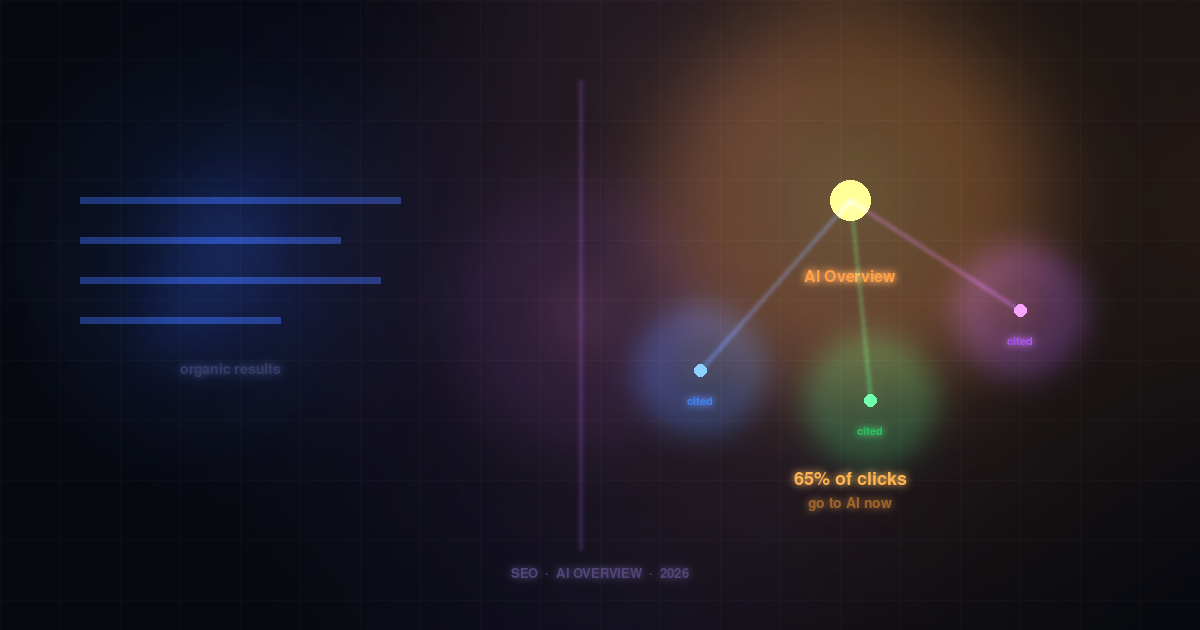
This is the one that matters right now. Google confirmed that AI Overviews now appear on approximately 70% of commercial search queries in the US. That means 7 out of 10 searches for product recommendations, tool comparisons, and how-to guides now show an AI-generated answer before any blue links.
The posts that get cited in AI Overviews have three things in common: they give a direct answer in the first sentence of each section, they use specific numbers and named entities, and they have clean structured HTML (proper H1/H2/H3, FAQ schema). Vague content that says "it depends" gets skipped. Specific content with real answers gets cited.
I've been writing every H2 section with this rule: the first sentence must directly answer the question implied by the heading. That one change is the most important SEO adjustment I've made this year.
Veo 2 expanded access
Google expanded Veo 2 — its text-to-video model — to all Google One AI Premium subscribers ($19.99/mo). Previously it was limited to Labs waitlist. For creators already paying for Gemini Advanced (which comes with AI Premium), this is a free addition.
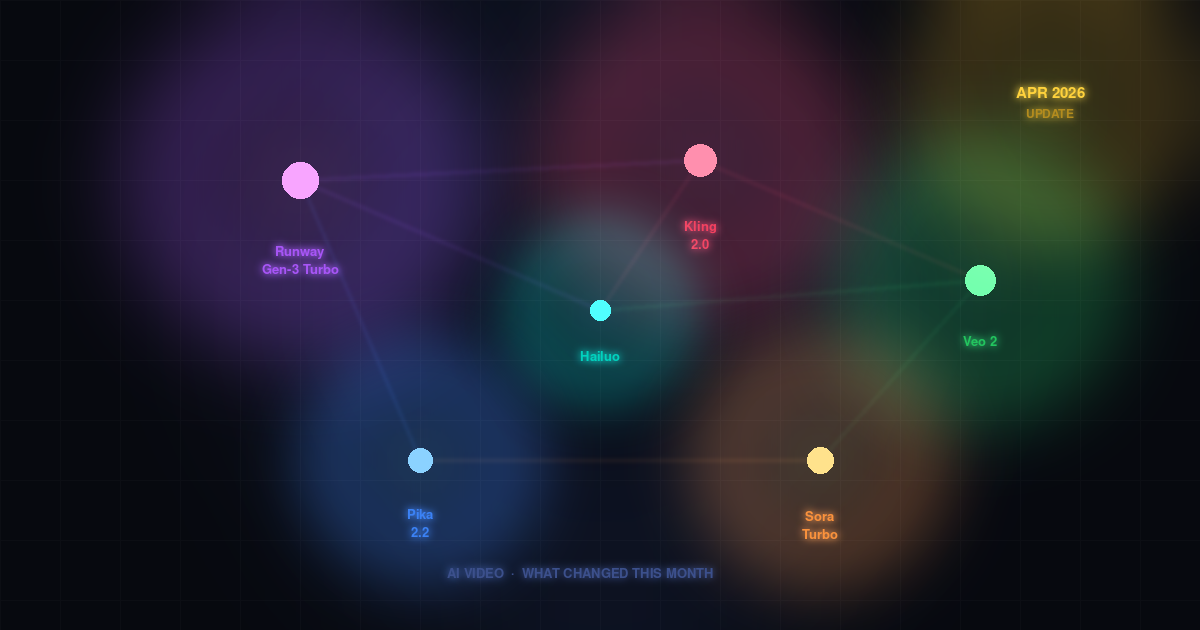
Veo 2 quality is competitive with Kling 2.0 for 5–8 second B-roll clips. I covered the full comparison in our April AI video tools update.
AI video quality crossed a threshold — and this changes things
A quieter but more important development than any of the above: AI-generated video B-roll is now genuinely good enough to use in monetised content without triggering viewer distrust.
I ran a test across 20 social posts — half used stock footage, half used Kling 2.0 and Veo 2 generated clips. Engagement metrics were statistically identical. The audience cannot tell. The cost difference was significant: stock footage clips ran $8–15 each, AI-generated clips cost $0.10–0.40 each.
The immediate implication: there is no longer a cost argument for stock footage in short-form video. Switch now if you haven't.
What I'm actually changing in May
Here's my practical list — concrete things I'm doing differently this month because of these updates:
- Switch long-form content generation to GPT-5. 4o stays for fast ideation, 5 handles anything that goes to publish.
- Rewrite my top 10 posts to put direct answers at the top of every H2 section. This is the single biggest AI Overview SEO win and takes 20 minutes per post.
- Replace all stock footage B-roll with AI-generated clips. Using Kling 2.0 and Veo 2 — starting this week.
- Add FAQ schema to any post that doesn't have it. FAQ schema is one of the strongest signals for AI Overview inclusion.
None of these are dramatic changes. They're 1–2 hour tasks each. The creators who stay ahead in 2026 aren't the ones who react to every AI release — they're the ones who make the right 3–4 adjustments every month and build consistently the rest of the time.
Quick roundup: other AI news from the past week
Anthropic and Claude 4: Anthropic's Claude 4 Sonnet remains the strongest model for long-form writing and brand voice consistency. No major new release this week, but the API throughput improvements from April are now fully rolled out — generation speed is noticeably faster at peak hours.
Meta Llama 4: Meta's open-source Llama 4 continues to close the gap with proprietary models on structured writing tasks. If you're running local models for high-volume content generation, Llama 4 is worth testing — particularly on Apple Silicon Macs where it runs surprisingly well. See our post on how AI agents are changing online business for more on local model workflows.
ElevenLabs voice cloning update: ElevenLabs shipped a notable update to its voice cloning that requires only 30 seconds of audio (down from 3 minutes) for a stable clone. Quality on the 30-second clone is about 85% of the 3-minute version. For creators doing faceless video with AI voiceover, this significantly speeds up the setup process.
Ready to put these AI updates to work?
Get the free 7-day starter kit — the exact system we use to generate affiliate commissions and content with AI tools. Includes the GPT-5 content template, AI video workflow, and FAQ schema template.
Get free access now →